
The Founding Designer

It was 4:00 PM on Christmas Eve when I dialed into the call. I assumed most companies had already shut down. The emails had stopped, and the Slack statuses had turned to little palm trees or snowman emojis. But when Vraj Shah joined the video call, he was clearly in an office.
“I am the only one here,” he told me. “I’m working on Christmas. I’m not taking any days off next week either. I’ll be the only one in the office then, too.”
He wasn’t complaining. In fact, he seemed content. Like a guy who had found a quiet moment to fix the things that had been bothering him.
Vraj is a Founding Designer designer at Peec AI. It’s a title I’ve been hearing a lot lately. It keeps popping up in Berlin and London, often attached to companies that are moving terrifyingly fast. Peec AI just raised a $21m Series A from 20VC and Singular; Runna raised over £5m before being acquired by Strava; and nsave raised $22.5m from YC and Sequoia.
I wanted to know what the job is like. So I talked to Vraj, Alp Turgut (Founding Designer at Runna) and Jonas Auernhammer (Founding Designer at nsave) to understand the role.
“Rectangles and circles”
There is a myth that you get this job by having the prettiest portfolio. But Vraj didn’t study design. He was an engineering student who got bored in his third year.
“I was pretty much done with my engineering side,” he told me. “I found a YouTube video where a guy was doing graphic designing on Figma. I opened up the tool... I explored literally rectangles and circles for a couple of days. From there on I learned more: graphic design, visual design, web design, no-code development, product design, UX. So I started working at a great agency first. And then I joined a fintech startup (nsave!) where I was the first product designer. I did pretty much everything around branding, marketing, logo design, and also product design of course.”
One phrase stuck with me: just rectangles and circles.
It speaks to the primitive nature of this role. You aren’t inheriting a design system or a brand book. You’re starting with just a business problem.
Jonas Auernhammer at nsave confirmed this scope. When I asked him what he does, he listed the following: “One part is product design - sketching the North Star for how the product should work. Another part is project management, bringing together operations, legal, and front- and back-end teams to get there (we have a fintech product where cross-functional collaboration is particularly important). The third part is growth work. We have only one design person, and building an extensive content library for the marketing team is essential.”
He even dips back into code. “Sometimes I also have to develop stuff for the website,” Jonas admitted. “You get what you sign up for.”
How to land the job
Landing the job can be just as scrappy. Vraj found Peec AI while browsing the web on a Tuesday. He saw potential (did freelance work for Peec AI’s direct competitor): “the product onboarding was amazing, that got my attention.” He texted a befriended Sequoia scout.
“I texted him, and within five minutes, the co-founder added me to a group,” Vraj said. “I was literally chatting with him five minutes later.” Five days after that text, he had the offer.
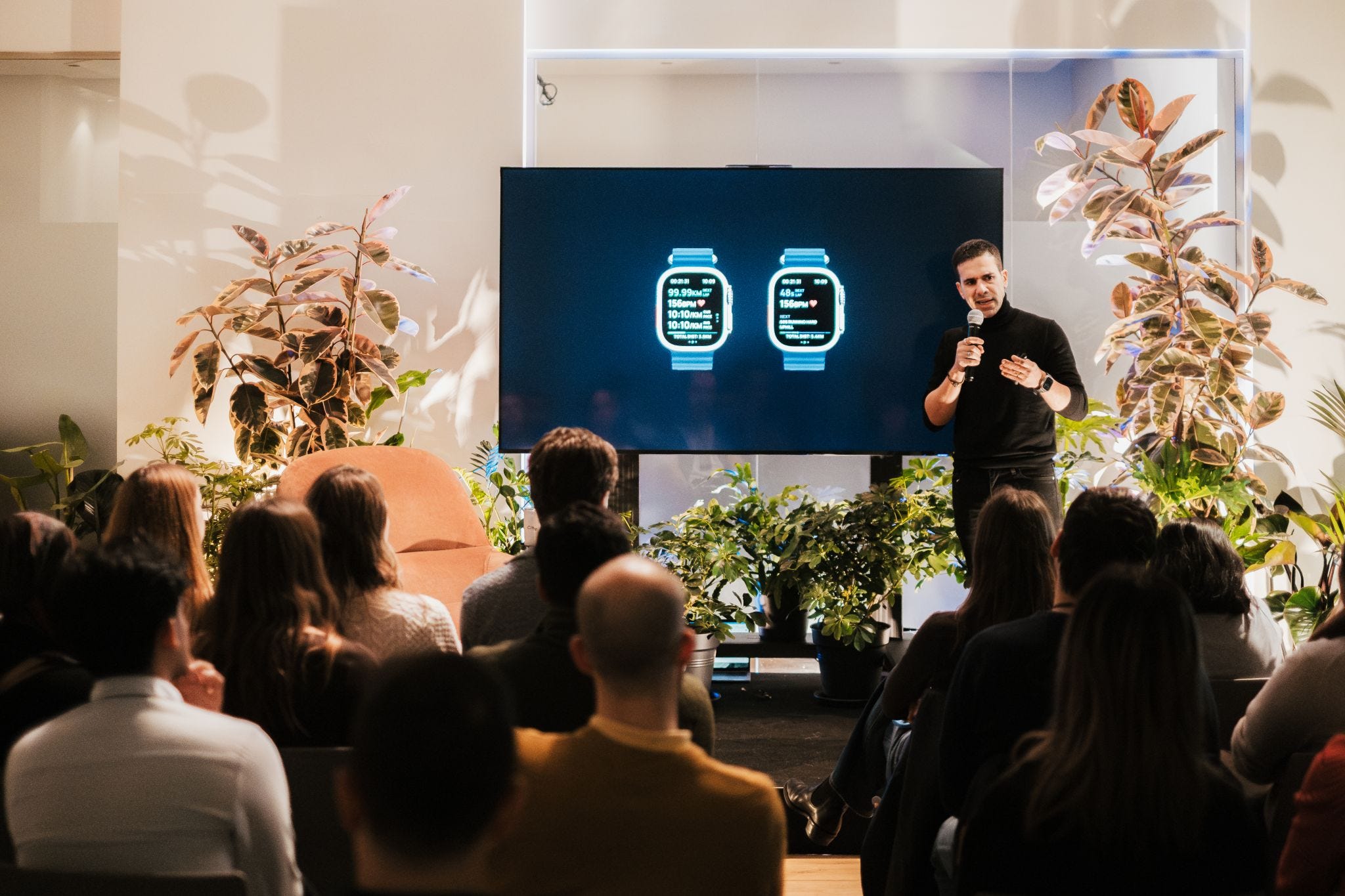
Alp’s story at Runna was almost identical. He came from Nike; he had designed the Nike Running Club and the Nike Training Club apps. When he saw Runna raise capital, he cold-messaged the CEO with a simple message: “I know running culture, and I can make this work.”
“The first thing I worked on was the Apple Watch app” Alp told me. “I saw the potential. The industry was switching towards wearables.”
“Sit next to me”
We tend to think of the designer as the person who makes things look “prettier first”. But Vraj was blunt about this. “I care about the UI, but usability comes first,” he said.
When he arrived at Peec, the company had been using an external agency initially. The agency had done what agencies do: they made a beautiful UI. It was polished and modern. It was also broken. “A lot of what existed didn’t align with the business logic,” Vraj explained. “There was a strong focus on UI, but not enough on UX".
“I took five days with one engineer,” he told me. “I said, ‘Just sit next to me. Let’s do this.’ I made him work on each and every pixel.” Vraj and the Peec AI engineering team spent five intense days heads down, fixing everything from tiny two pixel spacing issues to larger six pixel inconsistencies, while also rebuilding core parts of the UX logic from the ground up.
The real turning point came when Vraj finally met Marius, co-founder and CEO of Peec AI, in person in England. What he expected to be a casual coffee turned out to be a meeting at an investor’s office. During the elevator ride up, they quickly bonded over a shared ambition to build the best in the space. By the end of that day, Vraj had the job offer.
The weeks after were about shipping new product features, improving UX, simplifying the tool and redoing the information architecture.
Jonas, however, offers the counter-argument. For him, beauty is part of the function. “If a house is well designed and you go into it, the bathroom is not just in a random corner. It is in a certain place where it makes sense, and when the design of the house is great, it will also leave you with an emotion.”
For Jonas, working in fintech, trust is even more important. “If the app feels clunky, people don’t trust you with their money. You should have the feeling you’re using something built really well.”
The 6:00 AM problem
Whether they focus on logic or beauty, the job also comes down to saving the user from the business’s ambition.
The team at Runna wanted the app to launch on a “Plan View” - a massive, comprehensive calendar showing the user’s entire training schedule for the month. It made sense for the business. It showed off the scale of the platform. It looked impressive in a board meeting.
But Alp knew runners. He knew that when you wake up at 6:00 AM, in the cold, before coffee, you are fragile. You don’t want to see a mountain of data. You don’t want to be reminded of the 30 days of pain ahead of you.
“I knew that people are not really interested to see the whole plan,” Alp said. “They want to focus on the week they are actually on.”
Management wanted to revert to the big calendar. Alp pushed back. He proposed a compromise: a “Today” tab. “With the ‘Today’ view, you can actually focus on today,” he explained. “The Plan tab stays for the stakeholders, but the user lands on Today.”
Jonas faced a similar friction problem at nsave. Sending money can sometimes require, due to compliance, a large number of input fields to add a recipient. “We had the idea that when you want to send money home (to your own account), we already have your details,” Jonas explained. He implemented a simple toggle: Send to myself. “When you toggle it, 80% of the input fields just go.” A simple change that makes one of our core use cases feel seamless for every user.
It’s about stacking these small wins. As Jonas put it, “It’s about having 100 smart ideas that stack up on top of each other.” The customer feels this reduction in friction.
Vraj faced a similar challenge at Peec AI while working on the new Prompts feature. The team initially leaned toward a conventional approach using filters to organize topics. Vraj pushed back in this direction and suggested an alternative: making topics the primary navigation instead of hiding them behind a filter. His reasoning was simple by surfacing topics upfront, users would notice them more, engage with them sooner, and be more likely to adopt them as part of their workflow.
This diplomacy, standing between the “standard” requirement and the actual user behaviour, is perhaps the most important part of the job.
Good vs bad design
“This is a really vast question”, Vraj told me when asking what good design looks like. “Good design is clear and intentional. It makes the product easy to understand, solves real user problems, and supports business goals. Visual polish matters, but only after the fundamentals work.”
“So design starts with studying the business. Why are we building what we’re building? Define the user roles and goals, interview internal stakeholders, get to know as much as you can about user needs and about users, and then do quick prototyping. Use those to go back to the interviewed users.”
Alp likes to start with heuristic analysis. “Work with people who know everything about the market, and get accurate data in a very short amount of time. In addition to that, it’s also the customer experience team, social media, professional athletes. Then work out a prototype and show that to users. A/B testing really helps.”
For Jonas, good design comes down to service and emotion. “It has to help someone complete a task without thinking, while leaving them with a good feeling in the process. You build a great product or company by having a clear focus on a specific use case and by going the extra mile to make it the best experience on the market.”
The benchmark
I asked Jonas who he watches. Who are the companies that make a Founding Designer jealous?
He pointed to Trade Republic for setting the bar in German fintech. “They innovated navigation systems that everyone else copied,” he noted, admiring how they achieved high fidelity even when they were small.
He pointed to Apple, the “classic number one,” noting that even when they stumble (like the “liquid glass” UI), they still force the entire industry to pivot and follow them.
But his most detailed praise went to Wise (formerly TransferWise). For Jonas, Wise passes the ultimate branding test: anonymity. “You can remove the logo and still know it’s Wise,” he explained. “The custom font, the illustrations, and the 3D iconography that is “wrapped in bills” or has an “around the world” scheme. It conveys an emotion - that sending money is easy and fun - which is incredibly hard to do in finance. A lot of brands today only have the logo. Wise did a really good job.”
What happens as the design team grows?
Alp owned the whole design from the moment he started. “At first I was working closely with the CEO. After some time we hired two product managers, and I was working with both the PMs and CEO. After the acquisition this changed to working with the Strava design team and their PMs.”
This speed at which Runna scaled and got acquired is huge. At the very start you “have to move fast and do everything quickly. Limited time, limited resources, limited data also. Over time, as you reach a certain scale, you can spend more time on the research part. That’s when you can start focusing on quality, rather than the speed.”
Jonas is getting to a similar phase. He is doing the “hard tasks” (architecture) and the “easy tasks” (resizing banners for different countries). “The next logical hire would be a junior that can take over more of these easy-to-do tasks,” Jonas reflected. His ideal structure is small combat units: “Teams of two. One senior, one junior. Working on one project. If you have a team of 10 people, nobody feels responsible.”
Tooling & five principles
I asked all three what fuels this kind of work. For Vraj, it’s about speed and tools - Webflow, Framer (“better for simplicity”), Figma, Gemini (“super powerful nowadays”), Linear, Notion, Granola, Cursor, Lovable - anything to move faster than the competition.
Jonas keeps it tighter but heavy: Figma (80% of the time), Webflow, Blender for 3D work, and KeyShot for rendering.
But for Alp, it comes from somewhere deeper. He told me about his background, growing up in Turkey. “My career started a little bit later,” he said. “I had limited resources. The different culture, political problems... eventually, in a very short amount of time, with my talents, I came so far.”
He contrasted this with designers who have involved parents or a safety net. For Alp, obsession is a survival mechanism. He actually read me a list of principles he keeps for himself.
Mind your surroundings. (Always know what is happening in the market).
Constantly evolve. (You have to read, learn, and grow every day).
Unleash your potential. (Think ahead of the time).
Not impossible until you’ve done it. (One successful idea changes everything).
There is no finish line.
That last one seems to be the one that drives him the most. Alp told me he’s writing a book to share more on this., but is unsure when this will come out. “I’m also a street photographer and filmmaker, which is what I want to spend more time on as well. Perhaps my short film is coming out sooner.” I suggest you all follow Alp on LinkedIn and X to be the first to know.
The exit
There is a bittersweet quality to this work. If you do this job well, you design yourself out of the environment you love.
By all metrics, Runna succeeded: the company raised over £5 million and was acquired by Strava. For Alp, however, the acquisition marked a natural inflection point. As the strategy evolved and the organisation transitioned into a more corporate structure, the role and environment shifted away from what initially drew him to the company. “It stopped feeling like a startup,” he explains. “The strategy changed, the structure changed, and it no longer had the same sense of energy and enjoyment that it did in the early days.”
Jonas is still in the thick of it, fueled by the difficulty of the task. “You have to be passionate about it,” Jonas said. “If you just join a big corporate, you have a more chill life. You have to want to build something really good to enjoy this type of work”
As the call ended, it was clear Vraj wasn’t signing off for the day. He was heading straight back into the product. “I care about business, usability, and simplicity,” he said. Visuals come later, only after the solution is right
He wished me a Merry Christmas, reminded me to step away from screens for a while and spend time with family, and then went back to work.